
Intelligence Layer
- summarize and explain
- surface patterns and changes
- create risk signals as attention
- prepare documentation proposals
- make planning alternatives visible
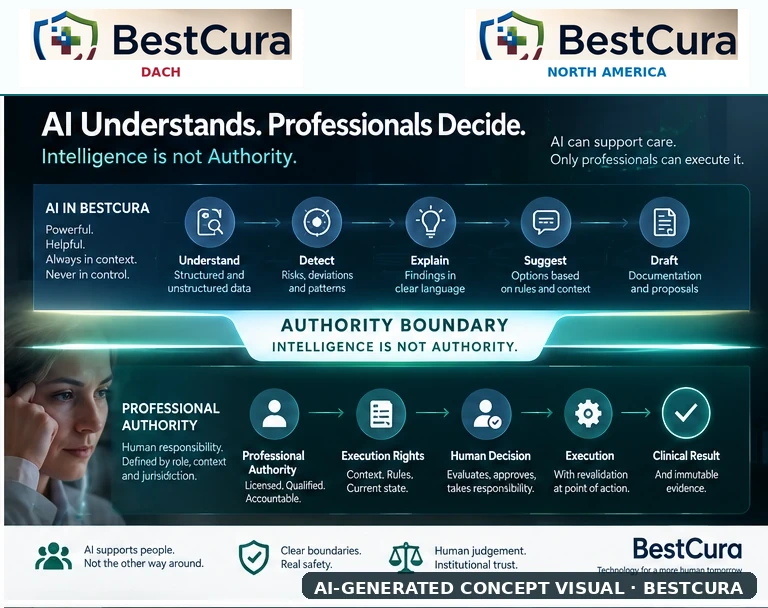
BestCura separates intelligence from authority. AI can compress information, surface patterns and generate proposals. Execution remains bound to state, rules, orders and human professional authority.
A model can say something is likely. It cannot by itself know whether an order is still valid, whether a professional is authorized for this exact action in this facility, whether clinical reality has just changed, or which jurisdiction-bound rule is actually applicable now.
A model produces a signal with provenance.
Care Flow makes the signal visible.
A professional interprets it in real-world context.
An action still requires order, rule and execution right.
Immediately before execution, current state is checked again.
The difference: AI may raise a question. It may not turn its own answer into an authorized action merely because the score is high.
BestCura uses AI where it can reduce burden and improve understanding. The boundary remains explicit: intelligence is not authority.
AI may think faster. It may not own more responsibility.
BestCura uses AI as a tool for people. Responsibility remains where context, professional judgment and real care meet.
AI can identify patterns, prepare summaries, prioritize risk, propose schedules or surface relevant information. The architecture deliberately separates that intelligence from clinical, financial, staffing and authorization authority.
An AI risk signal can create attention without becoming a clinical fact or treatment order.
Qualifications, availability, rules and authorized human action remain decisive.
Where AI is used, the system should preserve what was input, what was produced and who actually had authority to act.
Healthcare is not a collection of records. It is people, changing physical reality, uncertainty, responsibility and decisions under pressure. BestCura is therefore designed to connect information, evaluate rules, preserve evidence and expose contradictions without turning technical capability into automatic authority.
No. AI assistance does not automatically receive clinical execution authority.
Where implemented and enabled, AI may support summarization and report preparation while human review and responsibility remain explicit.
Because the question is not whether any human clicks a button. The relevant role must actually have authority in the concrete context.
The architecture separates economic derivations from canonical clinical facts to prevent economic backflow into clinical truth.