Measurements matter. Professional observation matters. Orders matter. No single representation should automatically become the whole reality.
BestCura / Hospital · North America
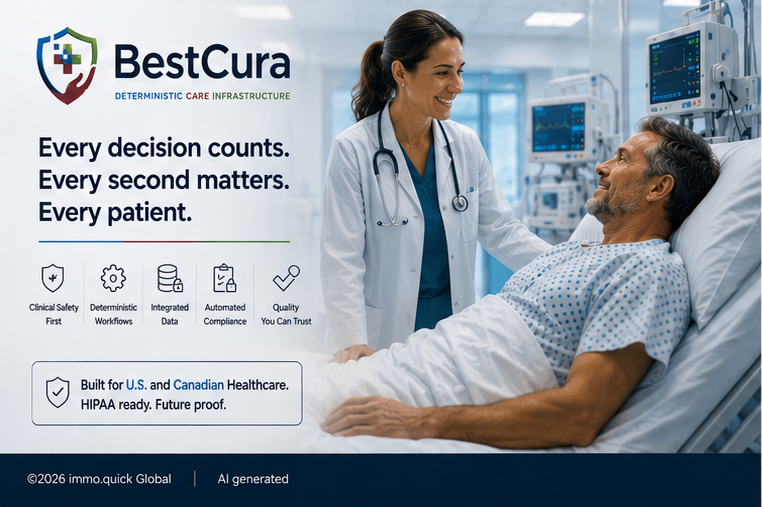
Hospital · North AmericaEvery decision counts. Every second matters. Every execution needs context.
BestCura is building hospital-specific execution environments around current clinical state, orders, professional authority, point-of-action revalidation, evidence and human control.
Care first
Technology should carry the complexity.
The surface must stay understandable for professionals even when clinical context, rules, authority, versions and evidence work underneath.
What BestCura can do
A work state instead of a patchwork of modules.
Capabilities are not designed as an isolated feature list. What matters is how an event changes the current state and the work that follows.
Clinical StateOrders, observations, medication, risks, access devices and relevant changes are connected to the current context.
Execution AuthorityAccess to information is separated from authority to perform a consequential clinical action.
Point-of-Action RevalidationState, order, authority and applicable rule versions can be checked again immediately before execution.
HandoffsChanged, blocked, stale, overdue and superseded work can be surfaced as explicit operational states.
Audit EvidenceExecution evidence and provenance are designed to preserve who did what, under which authority and against which state.
AI BoundaryAI may summarize, detect and forecast; AI output alone does not create execution authority.
Human impact
Less system work. More care.
BestCura should not confront professionals with governance terminology. It should show what changed, what matters, what is open and what can safely happen next.
Under the surface
What users see is the workspace. What runs underneath keeps it coherent.
BestCura deliberately separates a simple working surface from a deterministic clinical foundation. The surface shows people what matters now. The foundation keeps state, context, rules, authority, execution and evidence connected.
BESTCURA SURFACE
Care Flow · Work Dashboard · Clinical Workspace · Management Cockpit · Executive Dashboard
↓
01Clinical StateWhat is currently known?
02Context ResolutionFor whom, where and in which care context?
03Rule ApplicabilityWhich rules apply to this context?
04Authority & ExecutionWho may perform which action?
05Deterministic EvaluationAUTHORIZE · REVIEW · BLOCK
06Evidence & ProvenanceWhat happened, by whom and on what basis?
Evidence changes State.State changes Work.Work changes Care.Care creates new Evidence.
This explains the architectural operating model without disclosing proprietary rule definitions, internal data models, security implementations or execution details.
The Living Clinical Work State
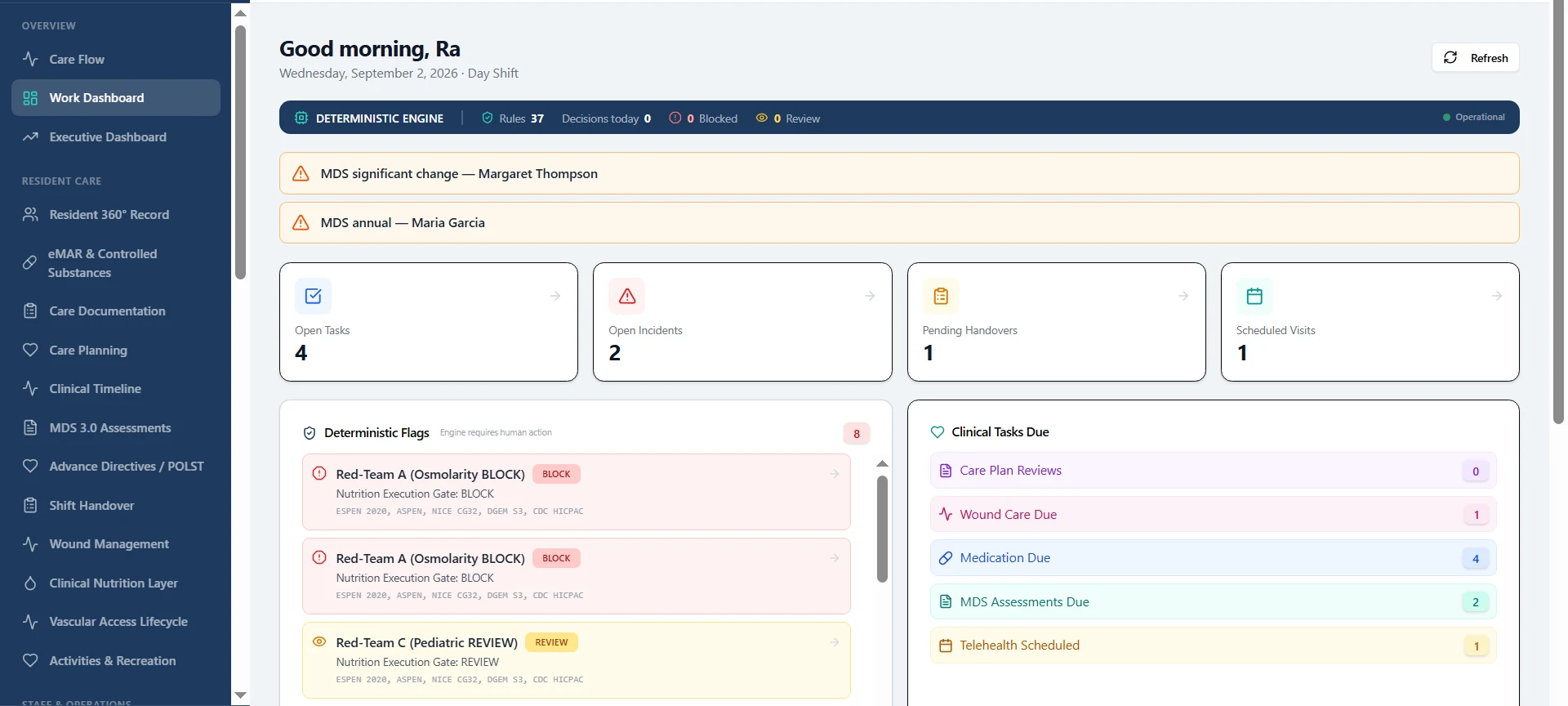
Care Flow turns system complexity into concrete work.
A professional should not have to search through dozens of modules. Care Flow condenses changes, open work, attention, handover and completion into the current working context.
Different role. Same governed state.
The surface changes. The foundation remains.
Nurses, physicians, quality teams and management do not need the same screen. They need different views of a coherent institutional state, with context and authority carried underneath.
NOWATTENTIONCHANGEDWATCHDONE
Executive perspective
Operational care below. Institutional steering above.
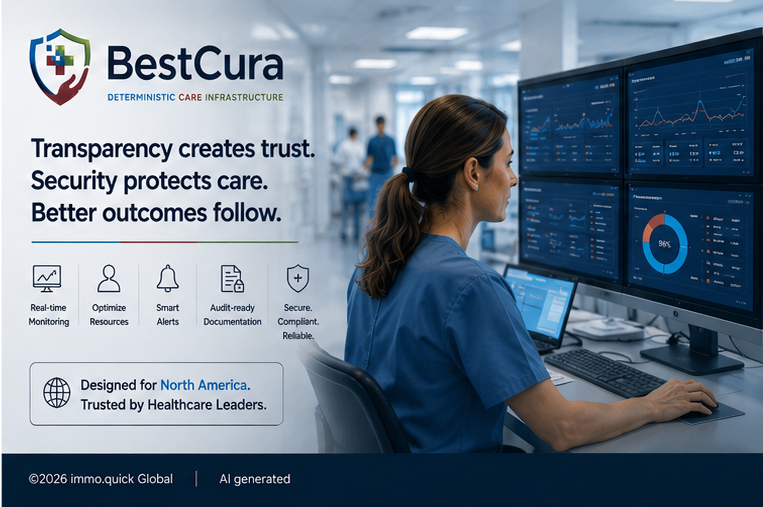
Management can see quality, reimbursement integrity, audit readiness, staffing and census without turning those metrics into the source of truth. They are views of the governed state beneath them.
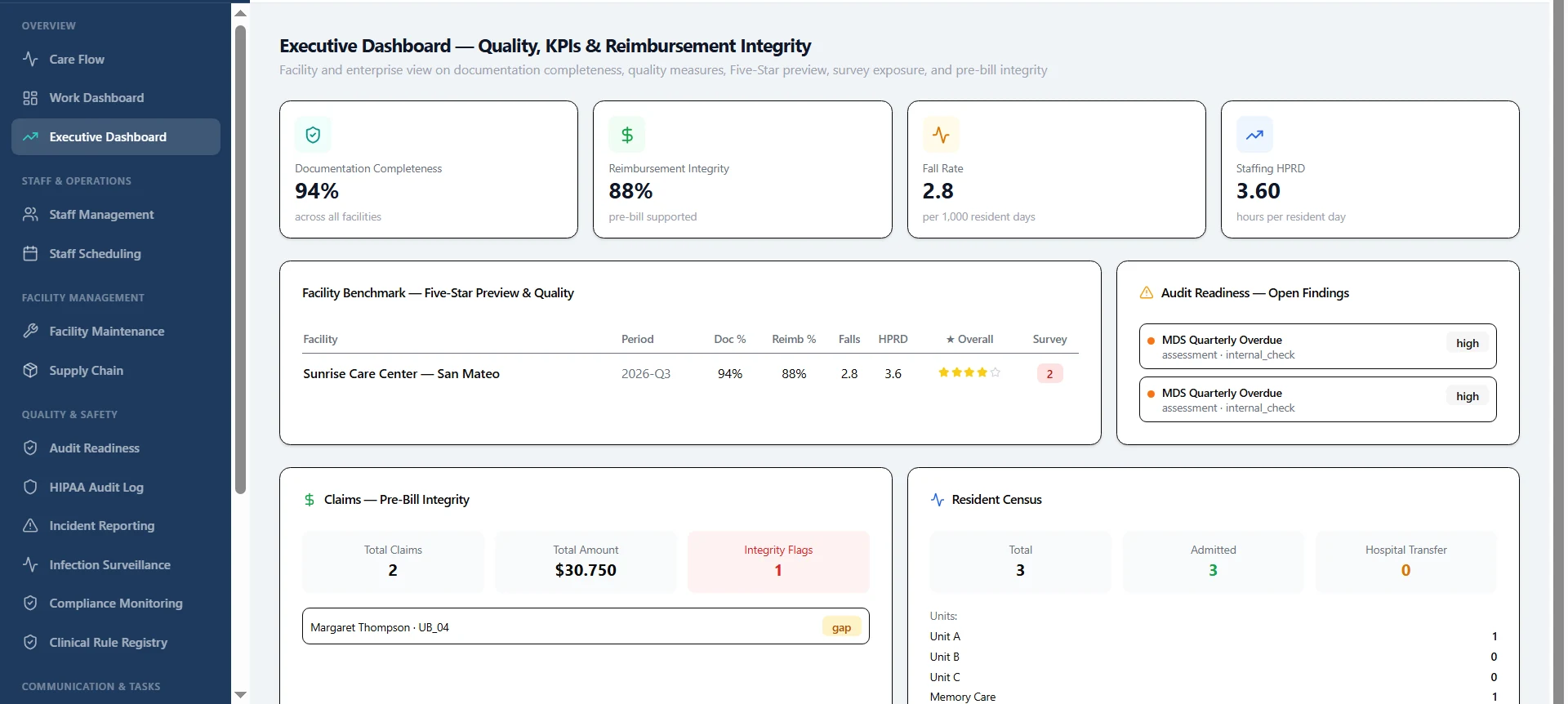
Explore the workspace
North America Hospital: a focused hospital workspace on the same foundation.
Workspace labels below reflect the actual environment supplied for this deployment context. The website explains their role without exposing internal implementation details.
Overview3
Care FlowWork DashboardExecutive Dashboard
Staff & Operations2
Staff ManagementStaff Scheduling
Facility Management2
Facility MaintenanceSupply Chain
Quality & Safety6
Audit ReadinessHIPAA Audit LogIncident ReportingInfection SurveillanceCompliance MonitoringClinical Rule Registry
Communication & Tasks2
Family PortalTasks
Integration2
FHIR / EHR SidecarTelehealth Visits
Administration1
Tenant Management
These categories represent the visible product surface. Not every role sees every area.
Regulatory context
Not just document. Work in the right context.
BestCura is not presented as blanket “compliant.” It is designed to bring applicable requirements, professional authority and evidence into context-bound work and execution logic.
HIPAA / HITECHPrivacy, security, access control, audit controls and ePHI safeguards are treated as core architecture concerns.
CMS Conditions of ParticipationHospital-specific workflows can be mapped to applicable institutional requirements and evidence needs.
EMTALA contextEmergency-care obligations can be represented as jurisdictional and workflow context where applicable.
Medication / controlled substancesMedication execution and controlled-substance workflows can be tied to authority and evidence.
State professional authorityLicensure, credential, facility policy, task and context are designed as separate authority layers.
Cybersecurity & auditabilitySystem state, access, execution and evidence are designed for traceability and operational review.
Note: exact legal and regulatory configuration depends on facility, state/province, care setting, contracts, professional role and deployment.
Traditional systems vs. BestCura
Beyond digital documentation. Care as one connected working state.
The difference is not a prettier screen. It is how the system responds when the reality of care changes.
Core logic
Traditional systemModules and screens
Information lives in separate areas and staff must connect the picture themselves.
BestCuraOne current care and work state
Changes in care update what is relevant, open, changed, or next for the people doing the work.
Documentation
Traditional systemStore entries
Documentation is often the endpoint of a workflow.
BestCuraChanges can create legitimate downstream work
A relevant new fact can update authorized follow-up work, handoffs, and evidence needs.
Safety & authority
Traditional systemRole and access
Access rights often define what a user can do across a module.
BestCuraAccess plus context-bound execution rights
Consequential actions are designed to require the right context, authority, and prerequisites at the point of action.
AI
Traditional systemAssistant or add-on feature
AI generates suggestions, summaries, or alerts.
BestCuraAI informs. Professionals remain responsible.
AI can surface and explain information, but it does not create execution authority by itself.
Audit & evidence
Traditional systemPrepare reports for review
Missing evidence is often discovered during audit preparation.
BestCuraKeep evidence needs visible during operations
Open evidence, relevant states, and gaps are designed to become visible earlier.
Economics
Traditional systemCare and billing are separated
Operational and financial reality are reconstructed across different modules.
BestCuraEconomic representation follows supported care
The financial view is designed to stay connected to care that was actually documented and can be evidenced.
Economic meaning
Care and economics should see the same reality.
BestCura targets the operational cost of fragmented state: searching, handoff loss, duplicate documentation, stale orders, preventable clarification loops and incomplete evidence. The goal is not automation for its own sake, but a more current and defensible operating state. Economic outcomes depend on deployment and baseline performance.
In plain language
What BestCura is not trying to be.
Does BestCura replace professionals or clinical responsibility?
No. Rules constrain, AI informs, professionals interpret, execution requires authority, and evidence preserves accountability.
Does BestCura automatically guarantee regulatory compliance?
No. BestCura can support regulatory requirements technically and operationally. Compliance also depends on configuration, operations, organization, contracts and actual use.
HUMAN FIRST · HOSPITAL · North AmericaA patient is more than a monitor. Clinical reality is continuous. Professionals need action clarity.
In a hospital, every second matters. And in every second, a person matters.
High-acuity care, devices, orders, medication, transfers and continuous therapies create enormous technical complexity. Patients should not have to see it. Clinical teams should not have to carry more of it than necessary.
A therapy does not end because a physical container changes. The system must understand continuity, not force care into disconnected events.
Under pressure, a wall of technical detail does not help. What matters is what applies now, what changed and what can safely be executed.
WHEN TECHNOLOGY MUST UNDERSTAND CLINICAL REALITY
The syringe changes. The therapy does not.
A continuous therapy is running. A physical container needs replacement without unnecessarily interrupting care. A traditional event model can misread that moment as a new administration or duplicate dose.
BestCura separates Therapy State from Container State. Order, rate, authority and current context can be revalidated at execution while clinical continuity remains represented as continuity.
Why that is human-centered
Because a clinician should not have to distort clinical reality just to make it fit a rigid software model. The system should move toward the reality of care, not force care toward the system.
TECHNOLOGY THAT STEPS BACKContinuousTherapyState Clinical Reality Reconciliation Execution Revalidation Care Flow
More technical depth underneath. Less cognitive load at the bedside.
A therapy is a state over time.
Container, device or access may change without the therapy losing its digital identity.
For teams: fewer artificial breaks in the digital representation.When a device and a professional do not say the same thing.
Conflict is surfaced rather than silently declaring one source unquestionable truth.
For teams: professional observation remains part of reality.An old authorization is not an eternal promise.
Order, authority, patient state or rule can change. Relevant execution is checked again at the action boundary.
For teams: present-tense safety.What needs my attention now?
The Foundation can be highly complex. The surface should translate it into role-relevant work and change.
For teams: clarity instead of a governance console.HUMAN CARE
BestCura should not stand between a professional and a patient. It should remove complexity from that space.
Technology is strongest when, at the decisive moment, it becomes less important than the human being it was built to serve.
Reality exists. Evidence represents. Rules constrain. Intelligence reveals. Professionals interpret. Humans care.
Talk with us about BestCura for hospitalsTHE WHOLE INSTITUTION
Care never operates in a vacuum.
Facilities, administration, workforce, care and quality affect one another. BestCura keeps these domains in one tenant-based institutional context without collapsing role or access boundaries.