No Clinical State replaces seeing, listening, touch, conversation or professional perception.
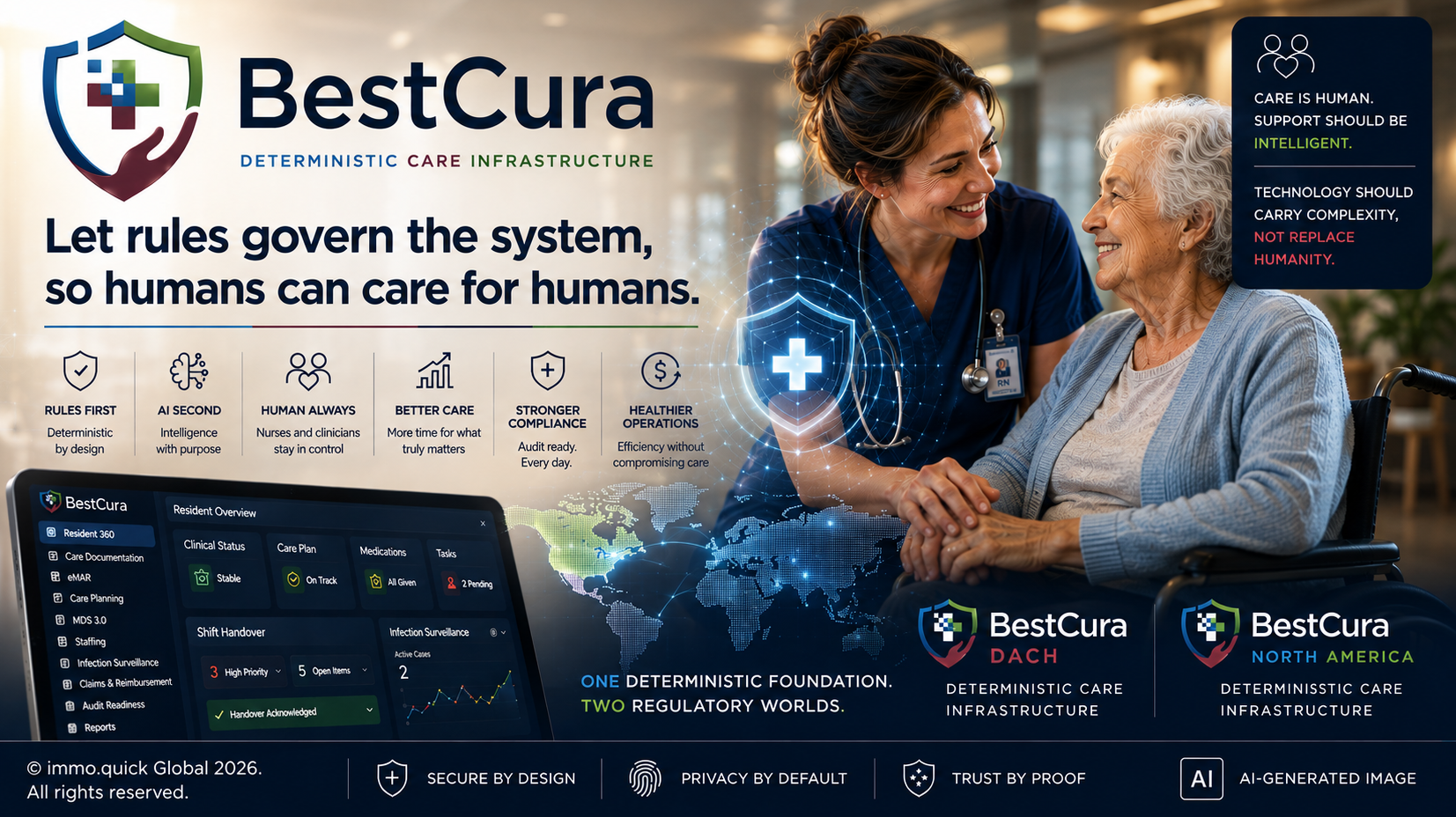
Care is human. Support should be intelligent.
More time for people. Less friction in the system.
BestCura is a Healthcare Operating System for senior care and hospitals. It connects the current state of care with documentation, tasks, medication, quality, authority, reimbursement and evidence. Not to replace caregivers and clinicians, but to make technology carry the complexity.
Senior Care & HospitalsNorth America & DACHAI informs, humans decideTraceability by design
CATEGORY DEFINITION
Healthcare does not need another piece of software. It needs an operating system for care.
BestCura is not a SaaS module, an AI copilot or another documentation application. BestCura is a closed Healthcare Operating System with a Deterministic Clinical Foundation. The foundation carries clinical state, context, rules, authority, execution boundaries and evidence. Care Flow translates that governed state into the living work reality.
The clinical foundation operates deterministically. AI components may provide intelligence, but they do not independently create execution authority.
BESTCURA HUMAN FIRSTCare is relationship Technology carries complexity AI remains a tool Evidence serves trust
A system can store everything about a person and still lose sight of the person.
BestCura uses a different measure. Not: how much can software take over? But: how much complexity can technology carry so people can give more attention to people?
Rules, versions, authority, jurisdiction and evidence belong below the surface, not in the head of a nurse under pressure.
Intelligence may inform. It must never pretend to carry the responsibility of the human professional.
Evidence is not the purpose. It should explain what happened, why it happened and on what authority people acted.
Why BestCura exists
Care does not begin with documentation.
Care does not begin with documentation.
Care begins with a person.
BestCura did not begin on a whiteboard. For years and decades, people in our immediate environment have worked in care and healthcare. We have seen the responsibility this work carries and how much time is simultaneously consumed by documentation, searching, coordination and administrative complexity.
That created a deeply personal ambition to rethink something fundamental. Not because other systems do everything wrong. Many existing solutions perform important work and have grown with healthcare requirements. We are choosing a different path. A path back to people.
OUR STARTING POINT
Why should people have to carry so much of the system's complexity?
BestCura is designed to carry the complexity a good system can carry, so people can focus more of their attention where technology cannot replace them.
People first
Documentation is necessary. But it should not receive more attention than the person it exists to serve.
Nurses, physicians and other professionals document, search, verify, hand over, coordinate and reconcile. This work is part of safe care. It becomes a burden when documentation turns into a second job alongside care itself and people must repeatedly carry system complexity every day.
Time to notice. Listen. Explain. Observe. Decide. Care. And time for the question that may never appear on a form.
Not blind trust in technology. Trust that relevant changes can be seen, open work understood and decisions traced.
Not a promise of absolute certainty. Clear states, context, traceable rules and responsibilities that provide a better basis for responsible action.
Residents. Patients. Staff.
When we say “people,” we mean everyone.
A resident is more than a record. A patient more than a diagnosis or case number. And a nurse is not a resource, a shift position or a metric.
Behind every shift is a person carrying responsibility, making decisions, experiencing difficult situations and remaining human long after the shift ends. A good healthcare system must therefore support not only residents and patients, but also respect the people who care for them every day.
BestCura is not simply about making care faster. It is about making the things that unnecessarily consume time easier: searching, collecting, transferring, reconciling, tracking and repeating. Time created by reducing that friction should not automatically belong to the next process. It should be able to return to where it is needed.
The BestCura Promise
Technology should carry complexity.
Technology should carry complexity.
People should have the space to care.
We believe healthcare technology must never become more important than the people it exists to serve.
We believe documentation is necessary, but it should not displace human connection.
We believe professionals need technology that supports their responsibility instead of adding more complexity.
We believe AI can inform and assist, but should not simply assume human responsibility.
We believe residents, patients and staff are more than records, cases, diagnoses, resources or metrics.
A different path.The way back to people.
From purpose to architecture
If people are to carry less complexity, the system has to carry more of it.
That is why Care Flow exists, and why a deterministic clinical foundation operates underneath it. Clinical State, Context, Rules, Authority, Execution and Evidence are not technology for technology's sake. They exist to make relevant work clearer, changes more visible and the surface simpler.
See how BestCura works underneath →What BestCura changes
A system that understands the workday.
Nurses, clinicians, administrators and leaders do not need more technical complexity. They need a reliable work state: What changed? What matters now? What is authorized? What is missing? What must be handed over?
01 · PEOPLE
Less searching
Relevant information and open work are brought together in the current context.
02 · QUALITY
See earlier
Risks, changes and missing evidence become visible before they disappear into daily workload.
03 · SAFETY
Execute legitimately
BestCura separates information from actual execution authority and revalidates consequential actions.
04 · ECONOMICS
Make care visible
Documented reality, quality and reimbursement are connected without letting revenue create clinical reality.
Four care environments
Senior care and hospitals. North America and DACH.
Interfaces, terminology, assessments and regulatory obligations differ. The core idea stays stable: a current, traceable and human-usable state of work.
Senior Care
Resident-centered care, eMAR, care planning, quality measures, MDS 3.0, reimbursement integrity, staffing, audit readiness and family communication.
Hospitals
A common clinical foundation for inpatient care, medication, orders, handovers, authority, evidence and hospital-specific execution environments.
Technology with a human purpose
The more complex BestCura becomes underneath, the simpler care should become above.
Hashes, rules, jurisdictions and revalidation are not burdens clinicians should carry through their day. That is why the foundation carries them. The surface should show what changed, what matters now and where a human is needed.
01
Foundation
State, context, rules, authority, execution and evidence explained clearly.
02Execution Authority
Why access and permission to perform are not the same thing.
03High-Acuity
Continuous therapy, devices and clinical reality.
04DACH + North America
One foundation, distinct authoritative jurisdictions.
05Transfer Integrity
Patient transfer as a traceable governed state transition.
06Red Team
40 adversarial scenarios with their limits stated clearly.
The difference
Traditional systems record what was documented. BestCura is designed to determine what applies now, what work follows, and whether a consequential action may execute now.
FOUNDATION v4.2 · CLINICAL & REVENUE INTEGRITY35/35Clinical Revenue Contracts 65Layer-0 invariants 9Mandatory suites 250/250Freeze v1.3 tests PASS
Clinical truth first. Revenue follows. AI assists.
BestCura connects clinical reality to MDS/PDPM derivation, Pre-Bill Integrity and Evidence — without allowing billing, administration or AI to silently rewrite the clinical source.
Economic meaning
Less friction. More provable care.
The economic leverage is not one feature. It comes from connecting documentation, quality, staffing, clinical work, audit readiness and reimbursement instead of running them as isolated islands. BestCura is designed to reduce duplicate work, surface missing evidence earlier, stabilize handovers and let only supported care flow into economic processes.
Explore
Explore BestCura by use case
Focused pages for important care and operational topics.
BestCura Authority
Understand healthcare. Define concepts. Explain architecture.
Insights, citable definitions and research on the next generation of institutional healthcare systems.
THE WHOLE INSTITUTION · NOT JUST THE CARE RECORD
From facilities to nursing. From administration to clinical care. One system — with the right view for each person.
BestCura is tenant-based and holistic. Departments receive role-specific workspaces while institutional state remains connected underneath. This reduces handoffs, conflicting truths and dependence on disconnected core applications.
One shared foundation
Facility state, care state, authority, work, evidence and operations belong to the same governed institutional context.
Many human perspectives
BestCura does not ask a nurse to think like administration or a facilities specialist to think like medicine. The surface follows the job.
UNDERSTAND BESTCURA VISUALLY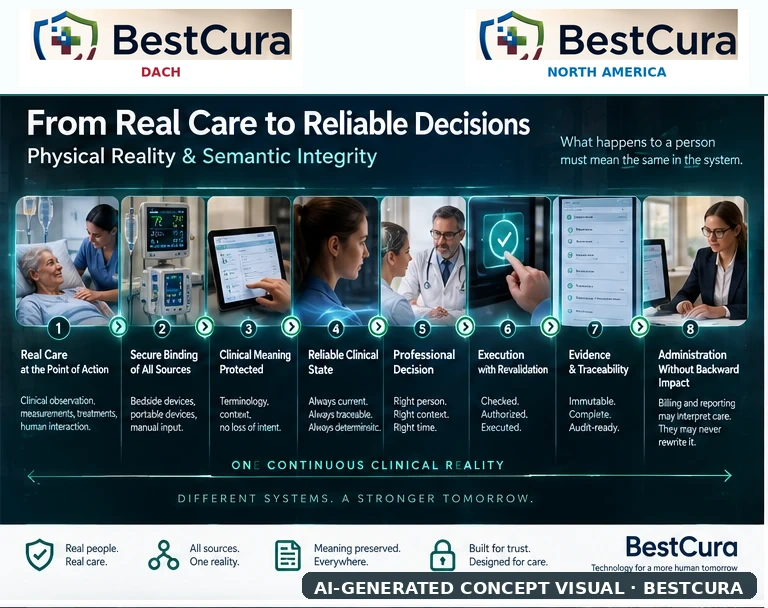 Physical realityHow real care becomes reliable clinical state.
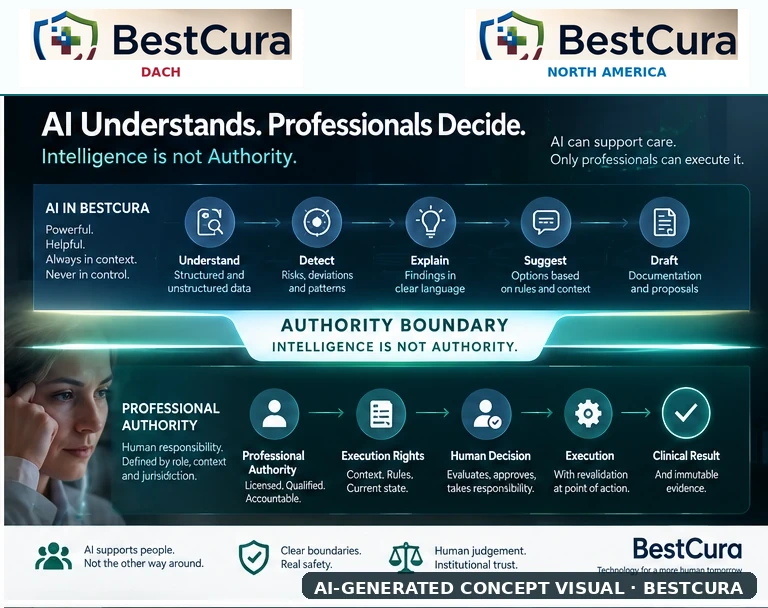 AI and authorityWhy intelligence may support care but cannot create execution authority.
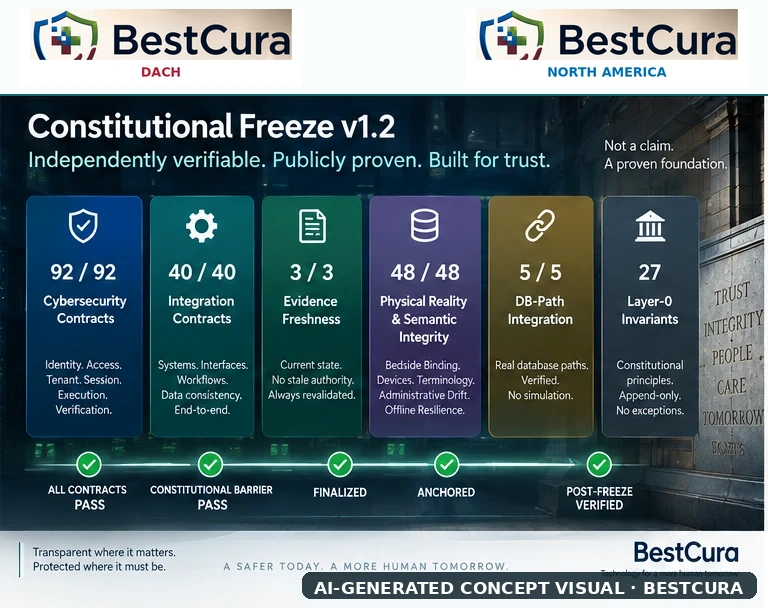 Security & evidenceLayered protection and the publicly visible Constitutional Freeze v1.3.
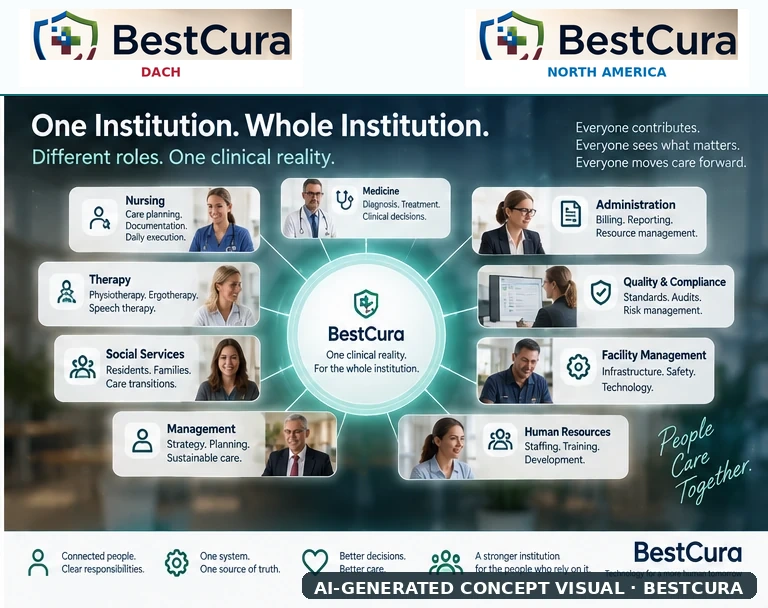 One whole institutionMany roles, separated permissions, one shared institutional state.
Complex healthcare architecture. Understandable in seconds.
The most important BestCura principles are now presented as mobile, accessible explainer diagrams. Every diagram is also explained in normal HTML text so meaning is never trapped inside an image.
Physical realityHow real care becomes reliable clinical state.AI and authorityWhy intelligence may support care but cannot create execution authority.Security & evidenceLayered protection and the publicly visible Constitutional Freeze v1.3.One whole institutionMany roles, separated permissions, one shared institutional state.
PEOPLE STAY AT THE CENTER. ALWAYS.
BestCura is not designed to make more decisions. It is designed to help people make better ones.
The strongest healthcare technology is not the system that removes people from care. It is the system that carries rules, context, history, authority and evidence in the background so nurses, physicians, administrators and leaders can focus attention where it cannot be automated: on people.
BestCura separates canonical facts from legacy data, AI outputs, economic derivations and technical timestamps. Things that cannot be proven to belong together are not silently reconciled.
A risk signal, recommendation or available record does not automatically create the right to act. Relevant execution remains bound to role, context, rules and the current state.
BestCura does not turn missing provider evidence, unresolved identity or unproven infrastructure states into green claims. That negative assurance is deliberate.
WHAT HAPPENS WHEN THINGS GET HARD?
A system proves its value when several plausible truths collide.
BestCura is designed not to guess faster, but to distinguish more carefully.
AI detects a risk. Can it change medication?
No. An AI signal can create attention, but not clinical authority. BestCura separates suggestion, rule evaluation, professional authority and actual execution.
Principle: Intelligence is not authority.
A legacy record only knows August 27. The new system turns it into 00:00 UTC.
That would invent precision. BestCura preserves DATE_ONLY and separates clinical time from migration time. A technical timestamp must never replace historical reality.
Principle: Preserve semantics before normalizing format.
Two names look identical. Is that enough to bind identity?
No. Historical messages or records remain deliberately unbound when proof is missing. Name similarity does not create identity authority or clinical visibility.
Principle: Unknown identity remains unknown.
The data is back after an outage, but the audit chain is missing.
Then institutional recovery is incomplete. BestCura separates data recovery, audit integrity, tenant boundaries and provider evidence. Recovery means more than being online again.
Principle: Restore the data. Restore the proof.
REAL SYSTEM. NOT CONCEPT SLIDES.
BestCura becomes concrete where care is actually organized.
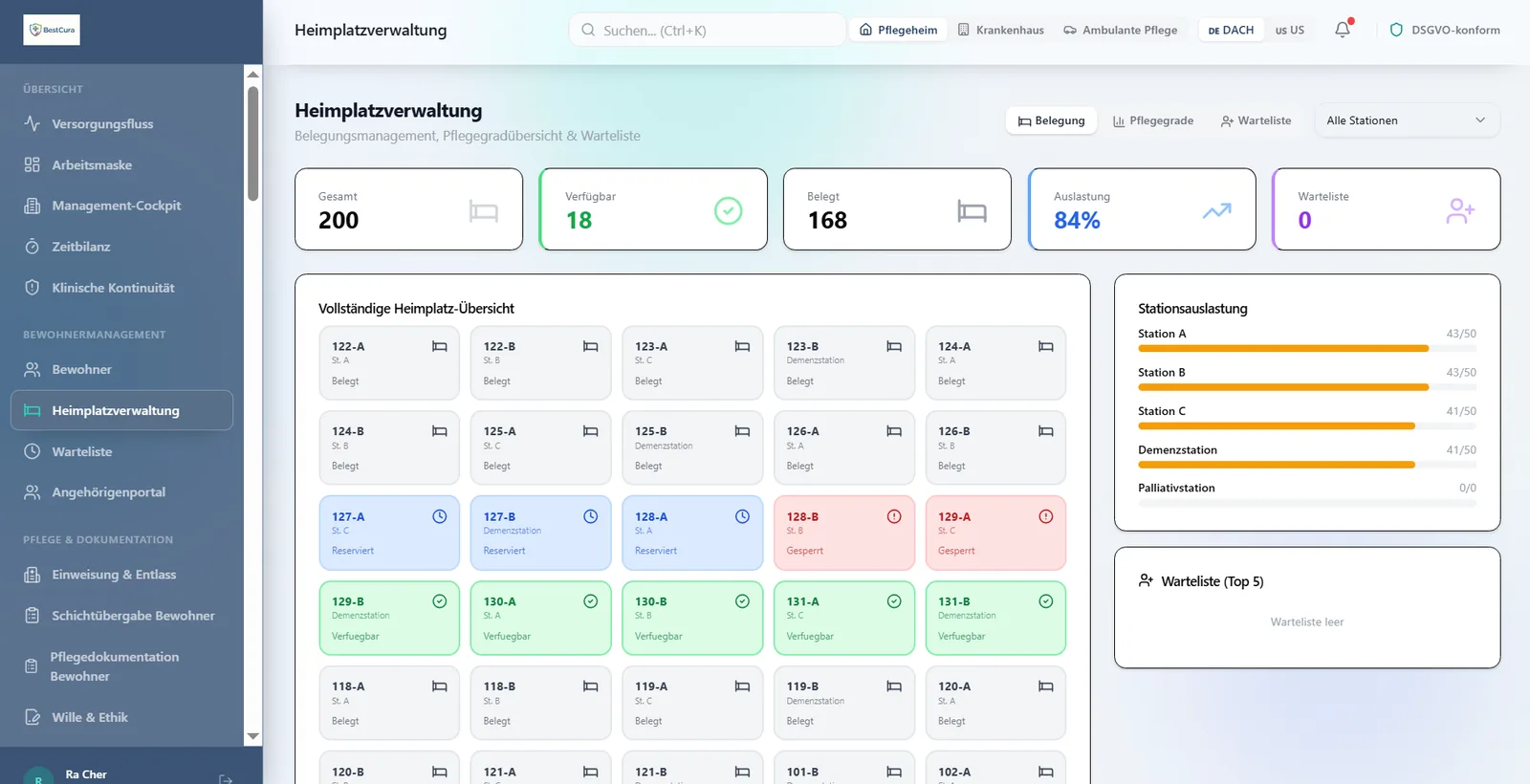
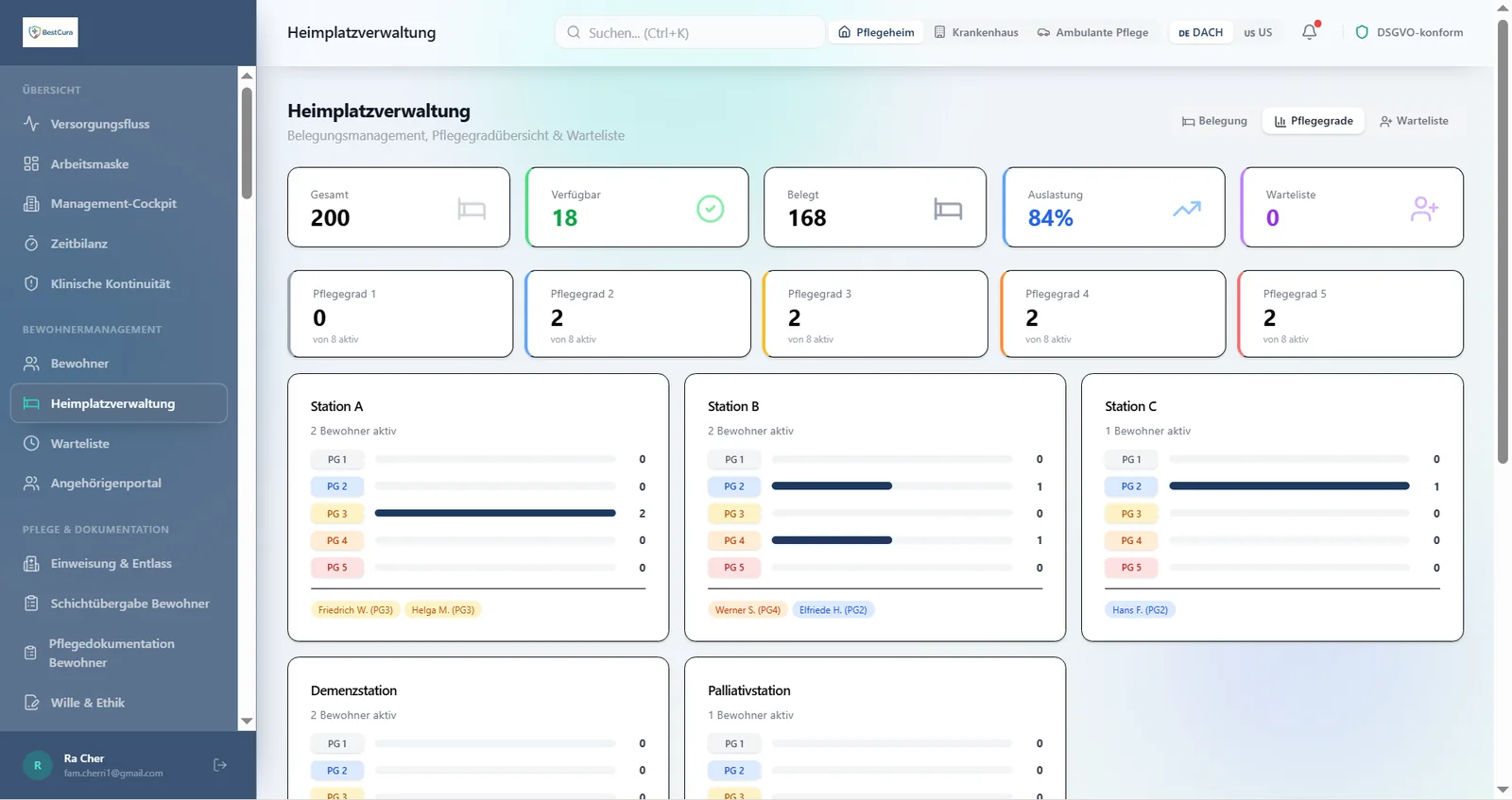
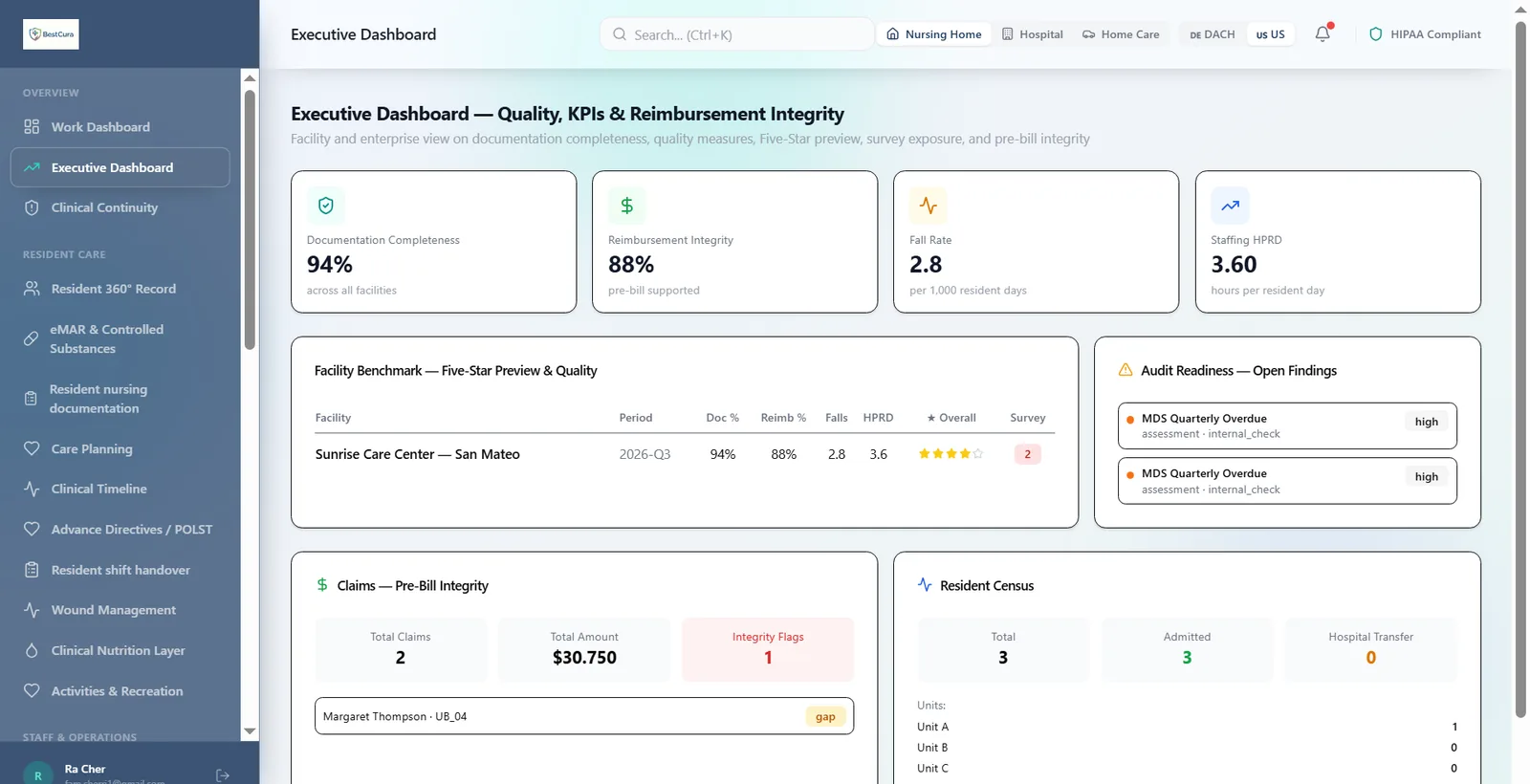
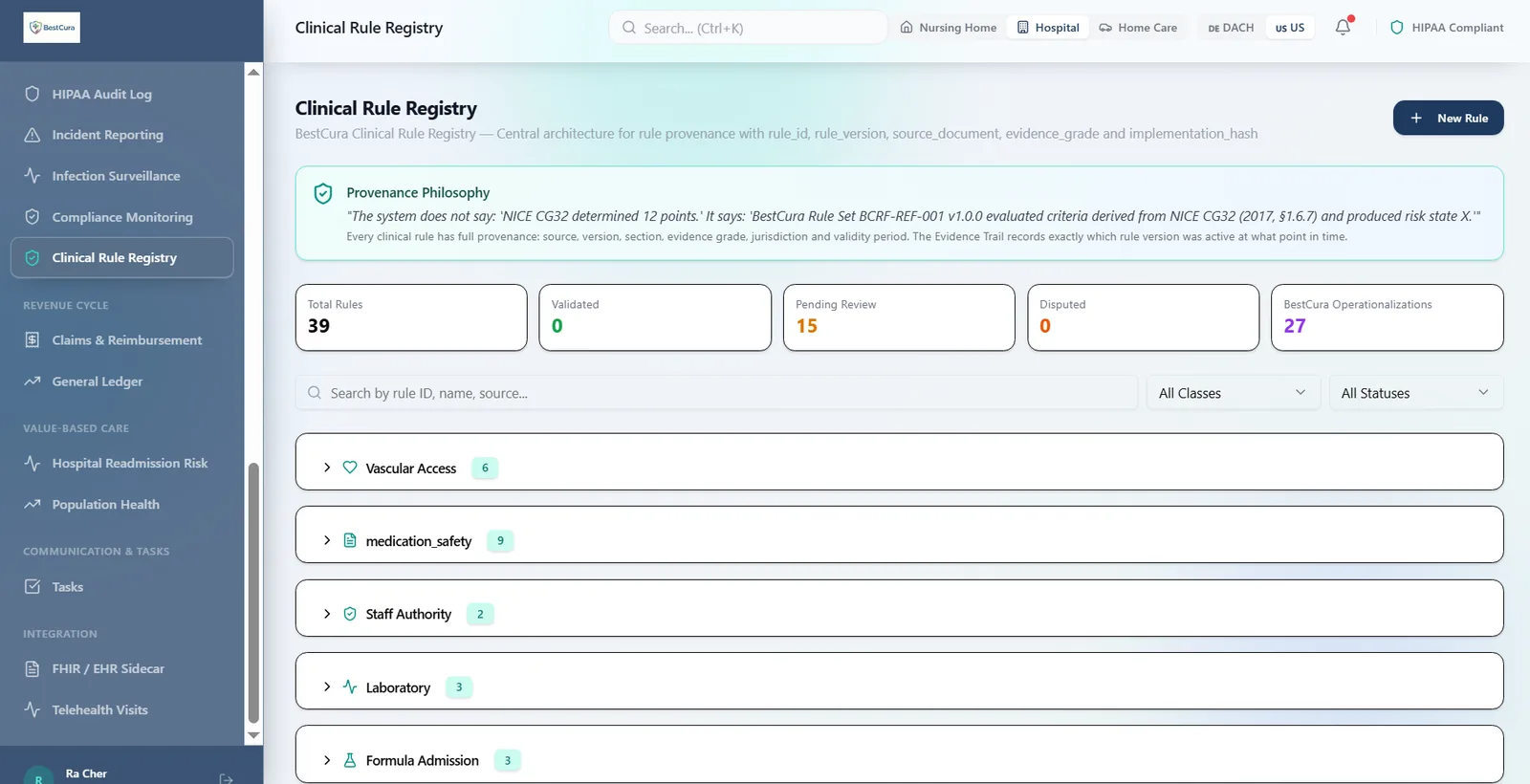
These views come from the current BestCura system. They intentionally show different perspectives: nursing home, hospital, DACH, North America, management, clinical rules and occupancy. The interface changes with task and context. The governed institutional foundation remains consistent.
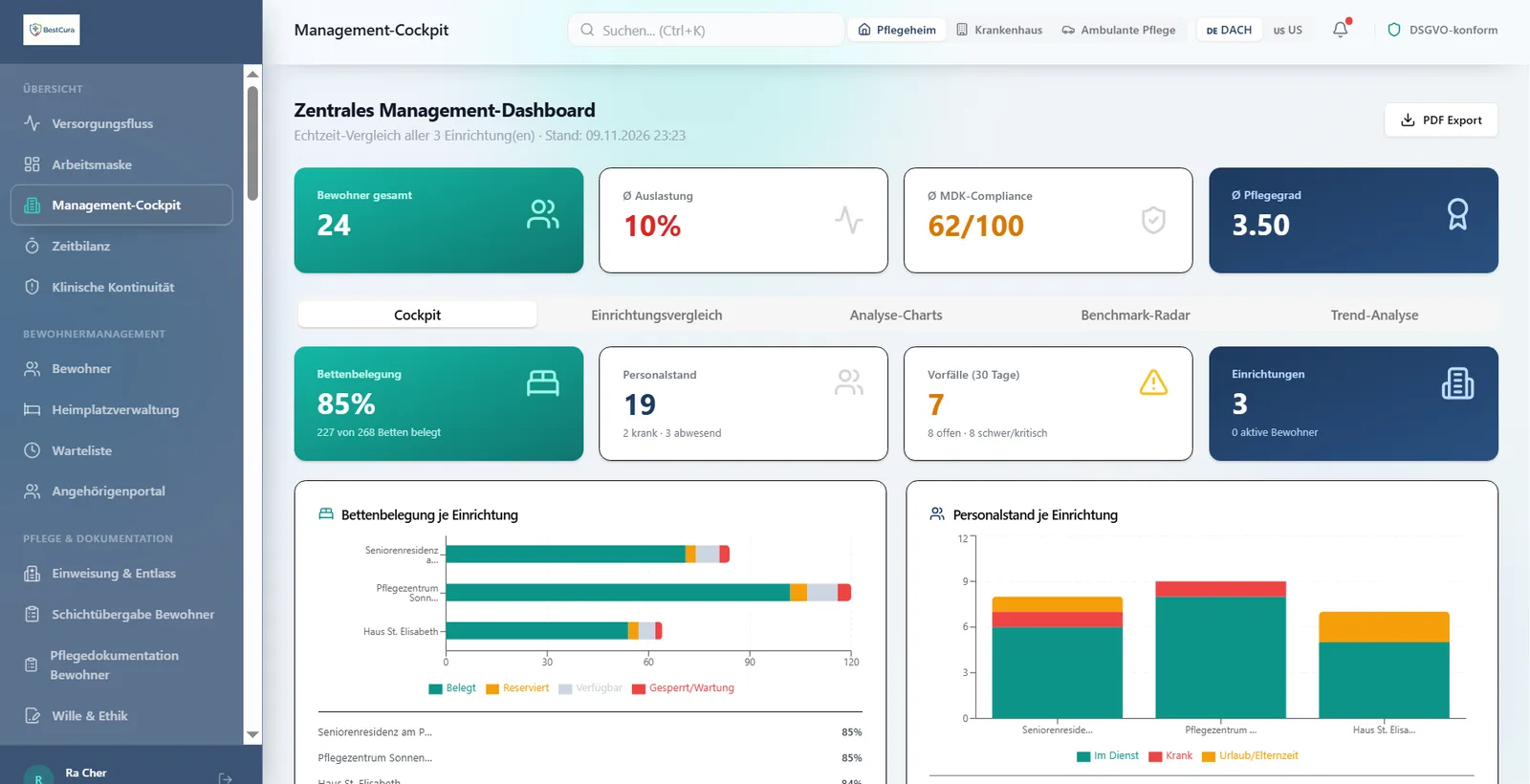
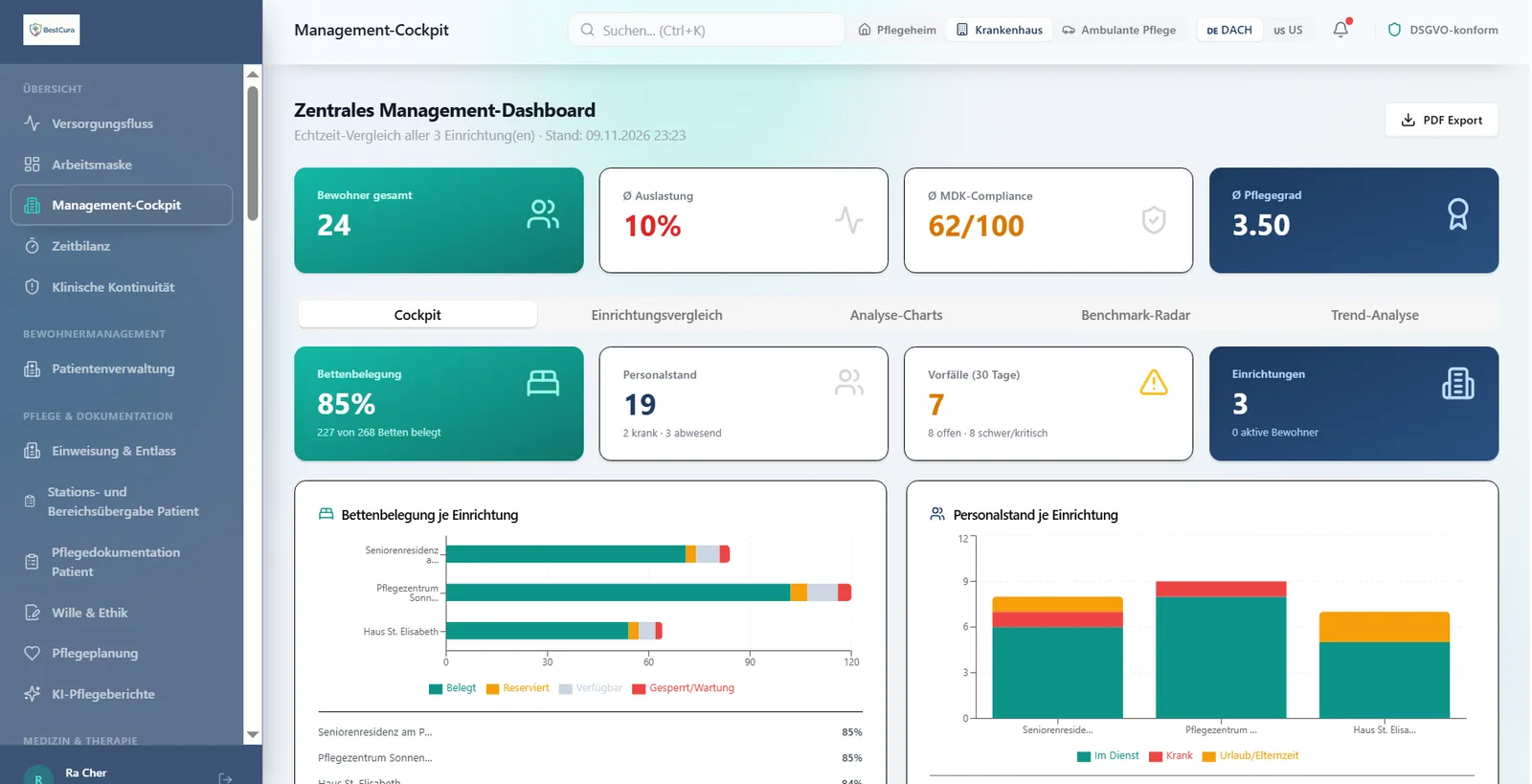
PROOF, NOT PROMISES
BestCura distinguishes between implemented, proven and unknown.
Many systems use words such as secure, compliant or AI-ready as product claims. BestCura treats such claims as states that must be supported. A technical function is not automatically proven. A submitted document is not verified evidence. A provider property remains unknown until it can be evidenced.
1 · Implementation
Does the capability exist and behave deterministically?
2 · Evidence
Is the claim supported by bound, relevant and current evidence?
3 · Assurance
Can the control actually be considered satisfied based on implementation and evidence?
4 · Acceptance
Only when mandatory gates are satisfied may an acceptance state be issued.
BESTCURA IN CLEAR ANSWERS
What BestCura is, how it differs and what it deliberately does not claim.
What is BestCura?
BestCura is a human-centered healthcare operating and governance infrastructure for nursing homes, hospitals and home care. It connects clinical and operational work with canonical data truth, rules, authority, evidence and controlled AI assistance.
Does BestCura replace nurses or physicians with AI?
No. AI may analyze, prioritize, summarize or propose. It does not automatically receive clinical, financial, staffing or authorization authority.
What does deterministic healthcare governance mean?
BestCura models rules, context, identity, professional authority and execution conditions so that relevant inputs produce traceable and reproducible outcomes, while uncertainty is not presented as certainty.
How is BestCura different from traditional nursing documentation software?
Documentation is one layer. BestCura connects current care, tasks, medication, handovers, clinical rules, staffing, quality, evidence and management within one institutional context.
Is BestCura designed for DACH and North America?
BestCura has separate regional and language projections for DACH and North America. Region, language, care setting and tenant are treated as separate axes. Translation alone is never treated as proof of regional support.
Why is “unknown” an important system state?
Because missing provider evidence, unresolved identity or an unproven infrastructure property is not automatically good or bad. BestCura distinguishes what is proven, what is open and what depends on an external source.
CARE BEYOND TOMORROW
If technology is going to help, it must first understand where its authority ends.
BestCura is for institutions that want to organize care not only digitally, but more clearly, more traceably and more humanly.