From facilities to intensive care: BestCura treats the institution as one whole.
People work in departments. Information should not fracture into departmental systems. BestCura creates role-specific workspaces on one tenant-based Healthcare Operating System.
Different roles, scoped access and one shared institutional state. Whole-system does not mean universal access.
THE DIFFERENCE LIVES BELOW THE SURFACE
Not six programs that must keep talking to each other. One system that understands the institution.
Nursing needs a different surface than administration. Facilities need different information than medicine. Leadership needs a different perspective than housekeeping. BestCura separates roles and responsibilities — without separating the institutional reality underneath.
Facilities & Maintenance
Incidents, rooms, maintenance, equipment and tasks without unnecessary access to clinical detail.
Administration & Revenue
Occupancy, master data, contracts, payers, finance and operations on the same institutional state.
Nursing & Care
Care Flow, medication, documentation, handover, wounds, assessments and clinical work state.
Medicine & High Acuity
Orders, continuous therapy, devices, clinical authority, revalidation and state transitions.
Leadership & Quality
Resources, quality, risk, evidence and institutional oversight without a second data world.
One tenant. One foundation. Role-specific workspaces. One shared institutional state.
Everyone sees and does what their responsibility permits. The institution does not have to synchronize its own reality between core applications.
A SIMPLE EXAMPLE
When an elevator fails, it is not only a maintenance problem.
A technical failure can affect mobility, patient transport, food service, evacuation planning and appointments. In a fragmented landscape that meaning travels through calls, tickets, handovers and separate applications. BestCura treats the failure as institutional evidence from which different work states emerge according to relevance.
1 · Facilities
The incident is captured once with responsibility.
2 · Facility State
The authoritative building state changes.
3 · Relevance
Affected residents, units or workflows are determined.
4 · Care Flow
Nursing sees only what actually matters to care.
5 · Leadership
Impact and resolution remain traceable.
No duplicate entryNo second truthNo universal data accessRole-specific viewShared evidence
TENANT-BASED BY ARCHITECTURE
Holistic does not mean everyone sees everything. It means everything belongs to the same governed institutional context.
01 · TENANT
The institution is the governed space.
Facilities, roles, responsibilities, policies and data relationships live in a defined tenant context, creating one foundation without dissolving professional boundaries.
02 · ROLE
The surface follows the job.
Maintenance does not need a medication screen. Nursing does not need an accounting workspace. BestCura presents work by role and context.
03 · STATE
One relevant change can matter across departments.
Not through manual copying, but because the same evidence changes shared institutional state and legitimate work states are derived from it.
04 · AUTHORITY
One system never means universal authority.
Read, edit and execute remain distinct. Professional authority, facility privileges and execution rights constrain concrete actions.
DIFFERENT FROM THE CLASSIC SUITE LOGIC
Integration is valuable. But BestCura does not want institutional reality to depend on separate core applications reconstructing it through interfaces.
MODULAR SUITE
Multiple specialized applications
Care, administration, workforce, analytics or finance may be organized as separate modules or products.
Data exchange happens through integrations, interfaces and handoffs.
The end-to-end process therefore depends more heavily on synchronization across system boundaries.
Users may encounter multiple application contexts and states.
BESTCURA
One Healthcare OS, many role-specific workspaces
One tenant-based institutional state as the shared foundation.
Care, administration, facilities and clinical teams do not operate on disconnected truths.
Professional boundaries are preserved through role, context and authority rather than separate core applications.
Care Flow translates the same state differently for each role.
Concrete market example: Connext publicly presents Vivendi as a comprehensive solution and lists separate components including Vivendi NG Stationär, Vivendi PD, Vivendi PEP, Vivendi CC, Vivendi Mobil and Diamant/4, together with interfaces and integrations between domains. That is an established suite architecture. BestCura deliberately starts elsewhere: one closed OS with shared foundation state and role-specific surfaces. Source: Connext product overview
AI IN BESTCURA
We use AI where it makes people stronger. Not where it would have to own responsibility.
AI is excellent at compressing information, surfacing patterns, structuring text and generating signals. Probability is not authority. That is why AI in BestCura never independently decides what may execute.
AI may assist
summarize handovers and documentation
surface meaningful changes
present risk signals and patterns as attention
structure, explain and contextualize information
generate planning or documentation proposals
AI may not govern
no independent execution authority
no invention of professional authority
no replacement of a clinical order
no silent choice of jurisdiction or rule when context is unresolved
no binding care-plan change without authorized human acceptance
ONE INSTITUTION · ONE SHARED STATE
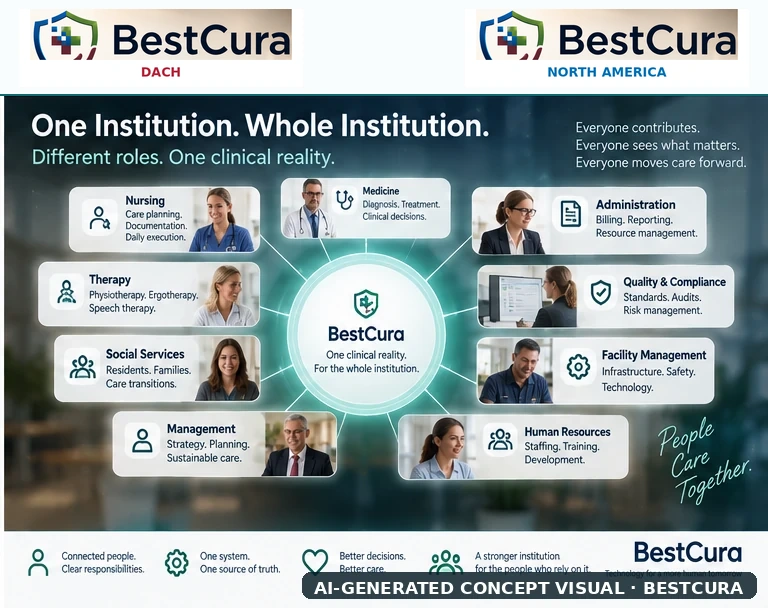
Every department contributes to care. Every role needs the same reliable reality.
BestCura is not only a workspace for nursing or medicine. Distinct roles operate within separate authorization scopes on one institutional foundation.
NursingObservation, medication, documentationTherapyPhysical, occupational and speech therapySocial servicesFamilies, transitions and social careLeadershipStrategy, planning and accountabilityHousekeepingOperations, hygiene and service delivery
BestCuraOne shared clinical and institutional state
MedicineDiagnosis, treatment and clinical decisionsAdministrationBilling, reporting and resourcesQuality managementStandards, audits and riskFacilitiesInfrastructure, safety and devicesHuman resourcesStaffing, training and development
A tenant may contain one or more facilities. A shared institutional state explicitly does not mean universal access.
The strongest technology is the technology that does not force people to think about technology.
BestCura should carry complexity across departments so facilities teams can run facilities, administrators can administer, nurses can nurse and clinicians can practice medicine.
One system for the whole institution. Not to make every job the same, but to make every job belong to the same reality.
BestCura connects institutional reality without dissolving professional boundaries. One tenant. One foundation. Many roles. One traceable state.