A category below the AI interface
AI functionality can be copied quickly. Governance architecture connecting identity, rules, authority, time, provenance and execution sits deeper in the operating model.
BestCura is not built around the next interface, copilot or workflow trend. It operates deeper: which data is authoritative, which rules apply, who is actually allowed to act, what evidence supports a claim and when the system must deliberately refuse to pretend certainty.
BestCura becomes particularly relevant where healthcare platforms scale, facilities are consolidated or AI moves from experimentation into operations. Every added facility increases not only the need for software, but the need for shared data truth, governable execution, evidence standards and portfolio-level assurance.
AI functionality can be copied quickly. Governance architecture connecting identity, rules, authority, time, provenance and execution sits deeper in the operating model.
When clinical truth, roles, rules, evidence, audit and workflows are modeled together, embedded operational context creates durability beyond UI lock-in.
Care settings remain clinically distinct while reusing governance and assurance principles.
A PE platform cannot standardize facilities through reporting alone. It needs shared rules, data definitions, evidence standards and management visibility.
BestCura does not try to hide uncertainty behind security or compliance language. That is highly relevant to diligence and regulated operations.
Healthcare platforms scale only if frontline work becomes clearer rather than more burdensome. BestCura is designed to carry complexity in the background.
The underestimated challenge in healthcare buy-and-build starts after closing: different documentation logic, local workarounds, incompatible data models, inconsistent quality definitions and management views reconstructed only at the reporting layer. BestCura targets that operating friction.
Facilities can retain clinical context while central rules, evidence standards and management logic become more consistent.
Canonical models and explicit migration reduce the risk of multiple operational truths surviving post-acquisition integration.
Evidence and acceptance states can distinguish what is implemented, proven, open or externally dependent.
Economic derivations can rely on clinical facts without rewriting those facts to optimize reimbursement.
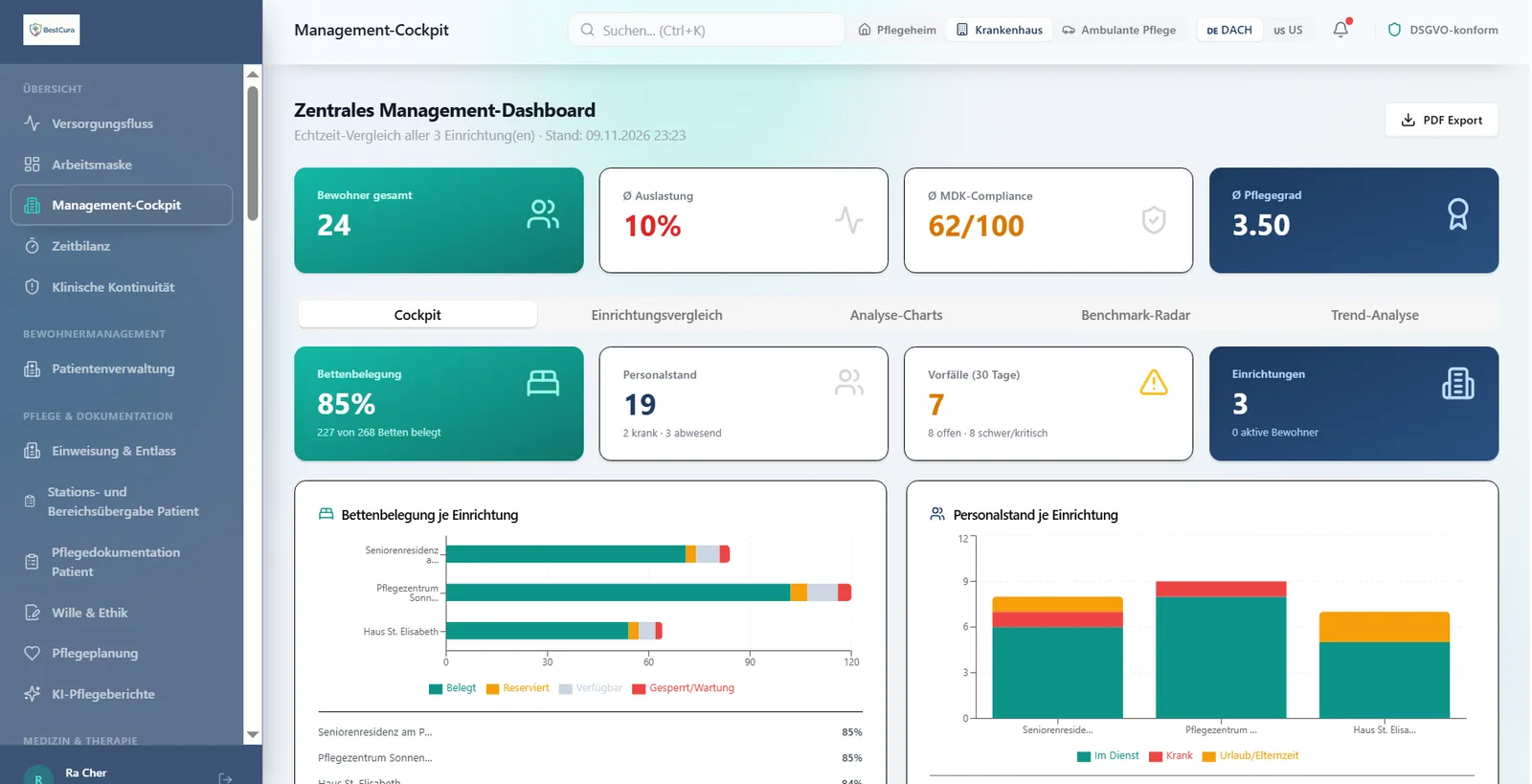
Executive views can compare facilities while senior care, hospital and home-care workflows retain distinct clinical logic.
Intelligence and execution authority remain separate, enabling AI deployment without delegating governance to the model.
The strategic question is who defines the governance layer on which AI, clinical systems and institutional execution will be allowed to operate.
Rules, provenance, canonical truth, migration, audit, evidence and acceptance have to fit together. The deeper that layer sits in operations, the harder it becomes to replace strategically.
BestCura frames healthcare systems around truth, authority, evidence and execution, not simply features. That changes how infrastructure is evaluated.
Strategic value increases when multiple institutions operate on shared assurance and governance principles.
Current interfaces show different institutional perspectives on the same underlying idea: human care, explicit responsibility and governance rather than one universal dashboard.
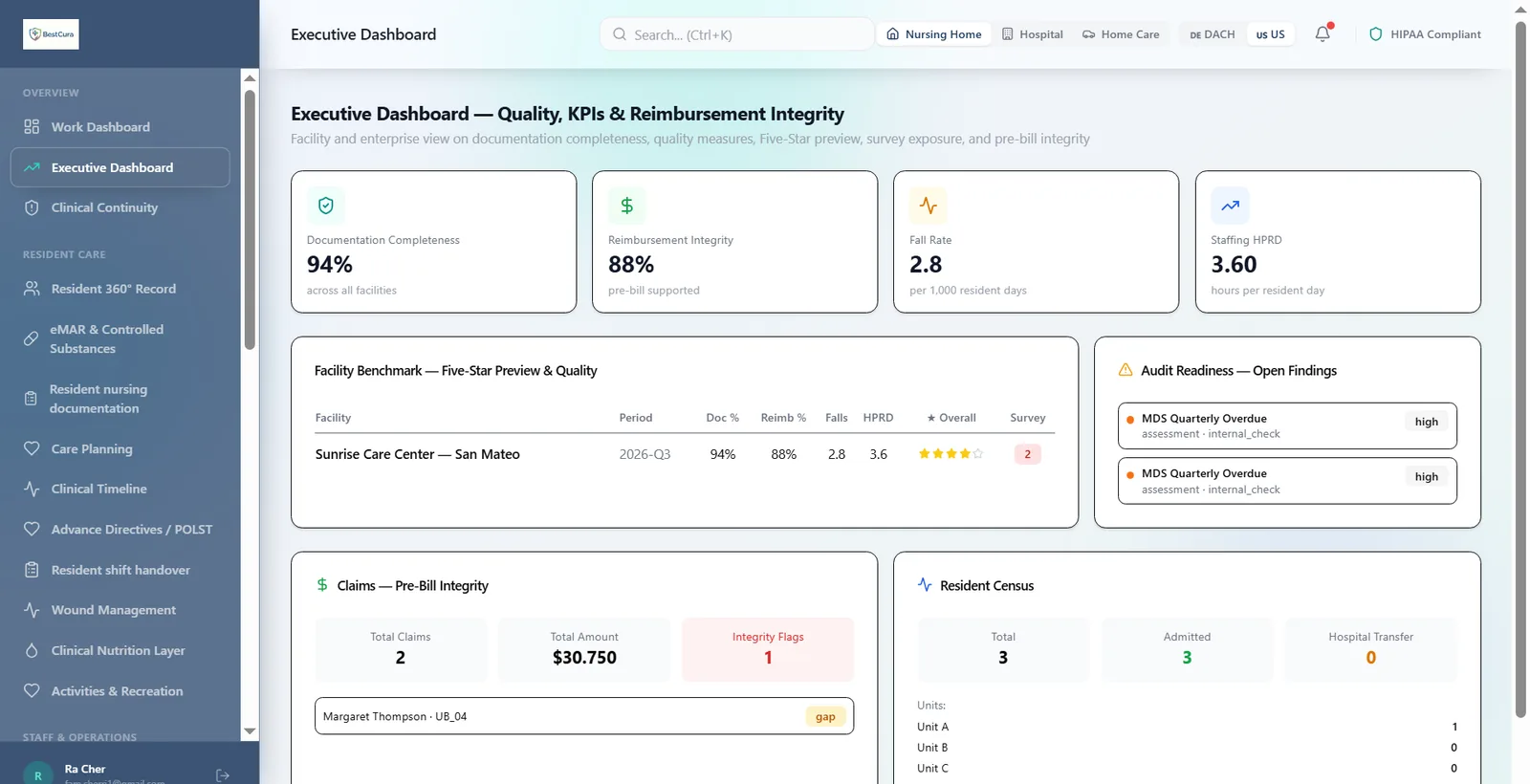
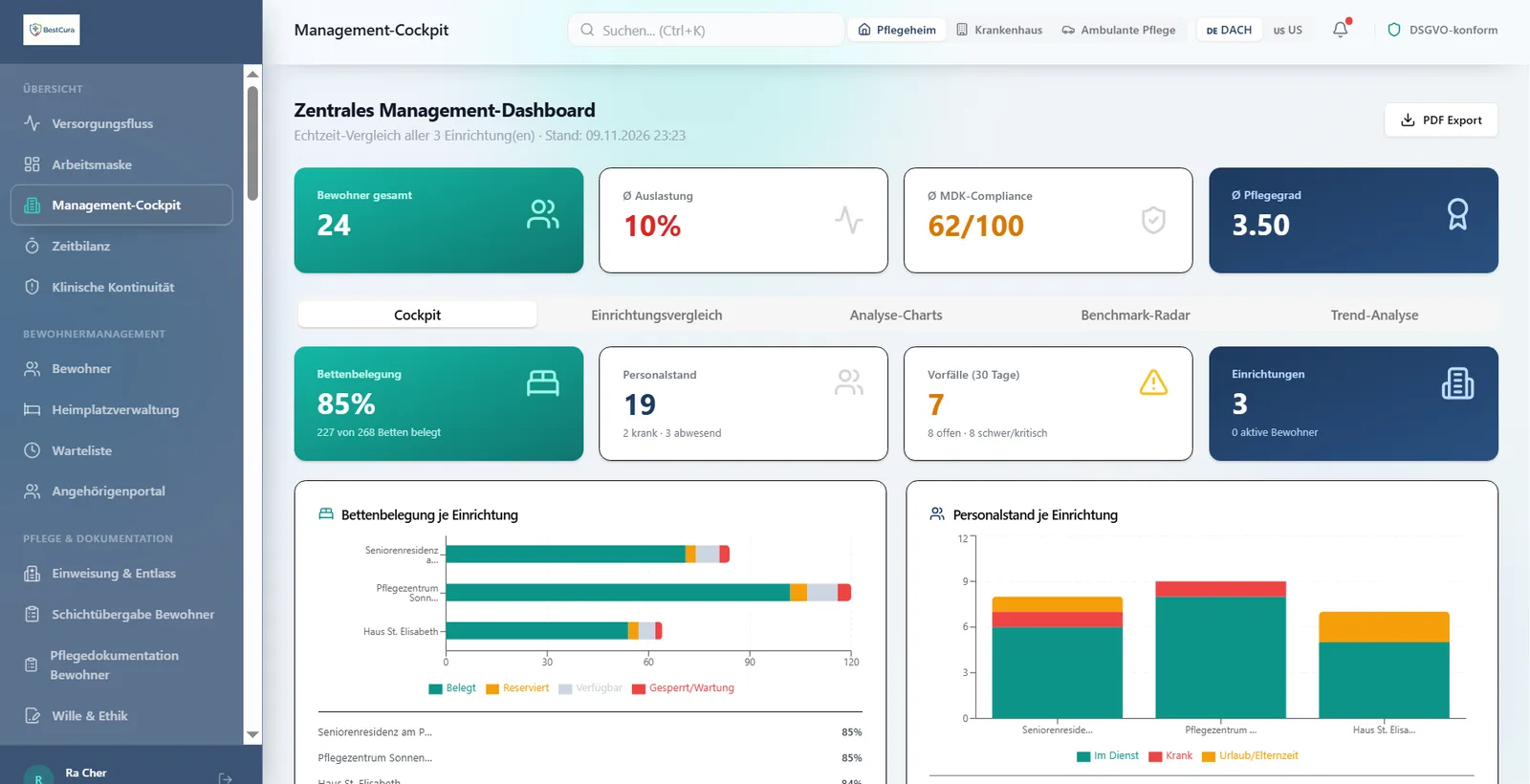
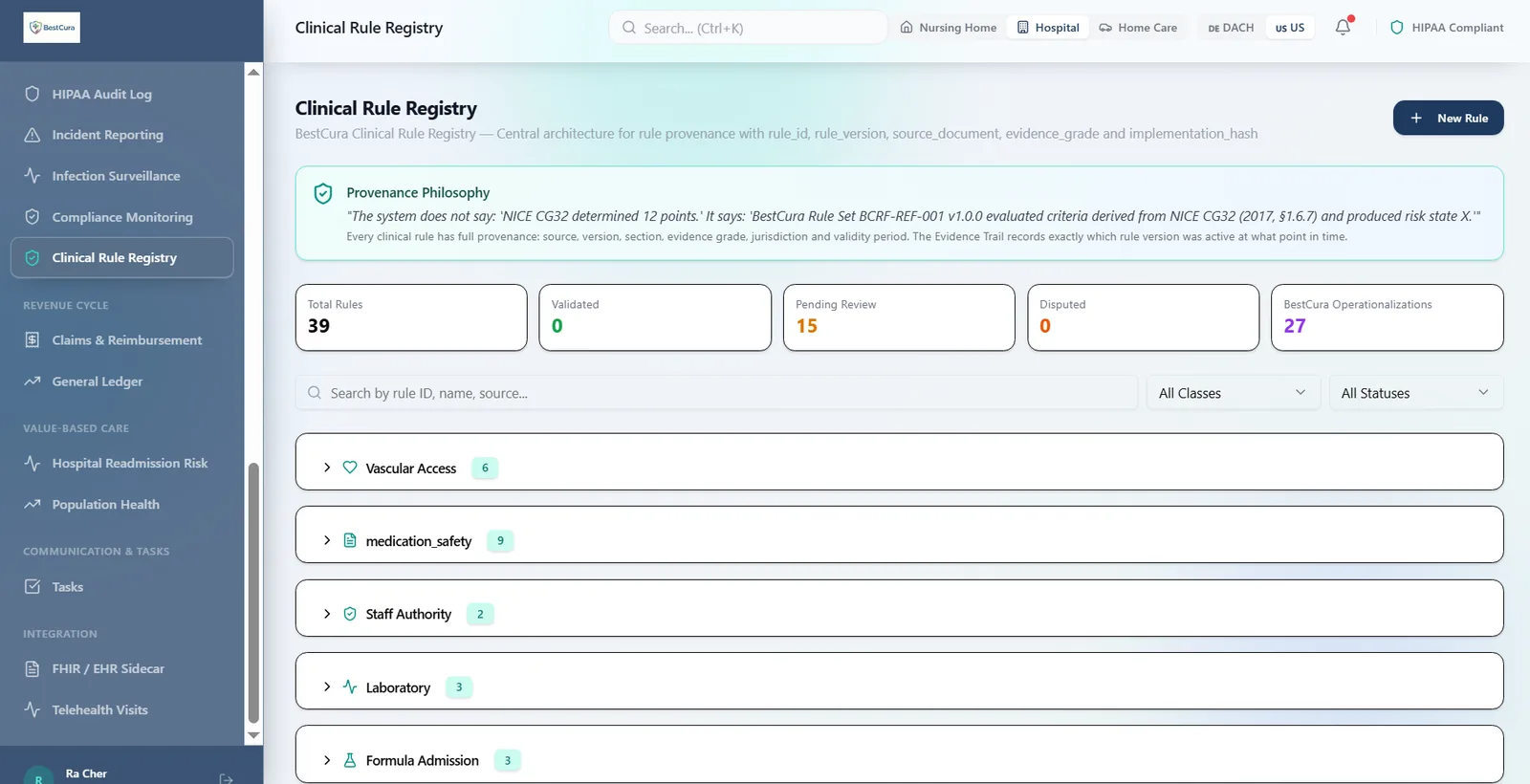
Healthcare buy-and-build is not only a reporting problem. Post-acquisition operations need shared data definitions, governance, quality logic, evidence and workflows across heterogeneous facilities without destroying care context.
A copilot sits on top of existing systems. BestCura targets a deeper operating and governance layer: canonical truth, authority, evidence, rules and execution.
No. BestCura separates acceptance domains. System integrity, canonical registry, incident response and DR can be accepted while infrastructure assurance or MFA remains open. Those gaps are deliberately visible.
BestCura uses institutional pricing on request. Commercial scope is shaped by care setting, capacity, deployment, governance depth and integrations.
Private-equity and growth investors, healthcare platforms and strategic buyers that scale institutional healthcare operations, standardize portfolios or want governed AI deployment.
If healthcare governance becomes its own infrastructure layer, competition shifts from individual features to who can make truth, authority, evidence and execution governable across the institution.
We discuss BestCura not as a feature bundle, but as potential healthcare governance and operating infrastructure. Conversations can cover architecture, system disclosure, deployment model, institutional pricing logic and strategic scale.