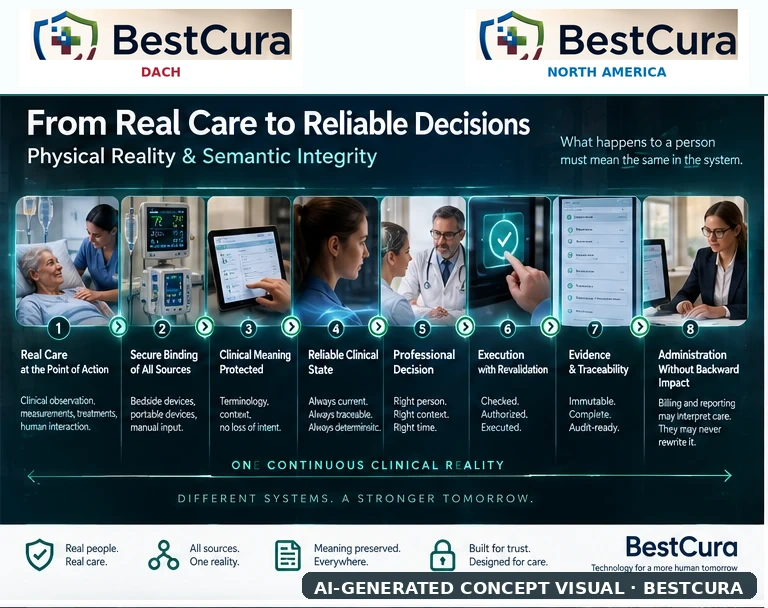
Digital systems have become very good at storing information completely, transmitting it in structured form and checking technical consistency. In healthcare, that is not enough. A record can be formally correct and still no longer describe the current reality of a person.
A mobility status may have been correct yesterday and be stale today. A medical value may have been transmitted without technical error but bound to the wrong patient. An order may still exist in the system even though it has already been professionally superseded. Even cryptographic integrity only proves that information has not been altered. It does not prove that it still belongs to the right person, time and care context.
When the database and reality diverge
BestCura therefore does not treat data quality as sufficient proof of clinical truth. If a nurse observes that a resident's condition has changed, software must not dismiss that observation simply because an older record says something else. At the same time, every manual change cannot become the new truth without provenance and review.
Between those extremes, contradictions must become governable states. When a device reading, human observation, existing order or temporal validity no longer agree, the conflict is not silently overwritten. The competing representations retain their provenance and move into controlled professional reconciliation.
Contradiction is not a software defect
A stale mobility representation, a device-human conflict, an order that no longer matches the therapy in progress, or an identity-binding conflict are not situations that should be solved by silently replacing one value with another. They are clinically meaningful conflicts.
The role of the system is not to invent a new truth. It is to make the conflict visible, preserve provenance and prevent unresolved reality from becoming an unnoticed action.
Correction without erasing history
Professional correction must remain possible. When a clinical state is corrected, the previous information should not disappear as if it never existed. The new finding is created as a new, attributable and justified state, preserving what was known before and why the state changed.
That changes the meaning of data quality. The important question is no longer only whether data is complete and formally valid. The more important question is whether it still describes the reality on which someone is about to act.
Learn more about BestCura
More feature articles and background are available in the BestCura Press & Insights Center. This article explains BestCura system logic and does not replace individual medical or legal advice.