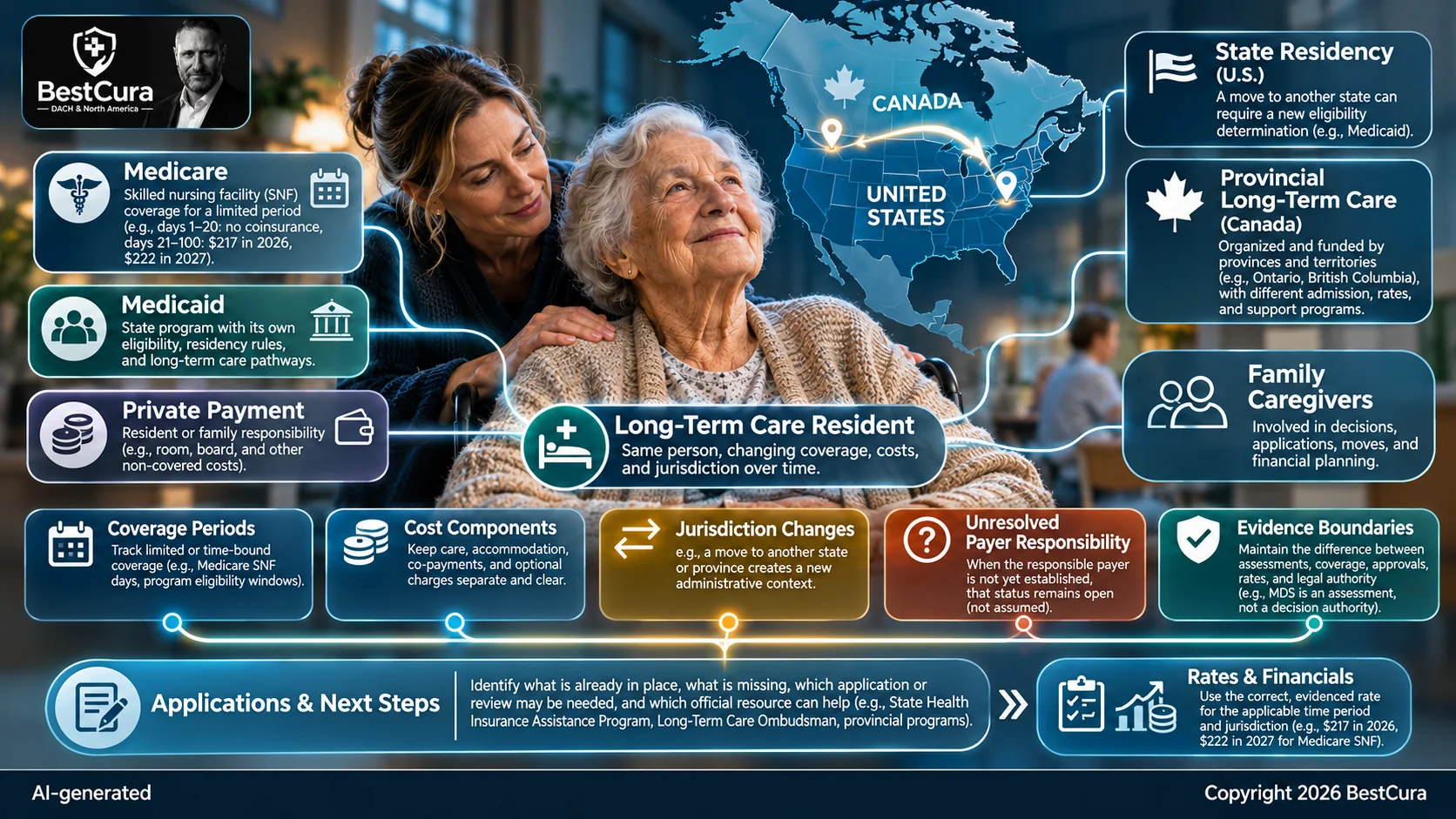
It rarely starts as a legal question. More often, a family says: “We want my mother closer to us.” Or: “The facility says Medicare is ending.” Or: “We are moving to another province — what happens to the current support?” These are life decisions for families. For care, funding and administrative systems, the same events can change several authority contexts at once.
That is where opacity begins. Care need, residence, facility, coverage, cost and jurisdiction often feel like one situation in everyday life, but they are not necessarily one legal or administrative object. A move changes location without automatically transferring every prior authority. A coverage gap does not automatically establish who must pay. An existing assessment does not automatically become a decision for a new state or province.
United States: Medicare does not simply turn into Medicaid
Medicare, Medicaid and private payment are not interchangeable payer fields. Medicare Part A may cover qualifying skilled nursing facility care for a limited period when the program conditions are met. When that coverage changes or ends, it does not automatically mean that Medicaid becomes responsible. Nor does it automatically prove that the resident legally owes every remaining charge.
BestCura therefore separates care-status evidence, coverage episodes, cost components and rate authority. The system can show what was clinically established, which period is evidenced as covered, which cost component is being discussed and whether an applicable rate has a valid source and effective period.
Canada: one country, distinct provincial long-term care contexts
Canada cannot be modeled as a single long-term-care authority domain. Provinces and territories organize major parts of long-term care delivery and financing. A move from Ontario to British Columbia can therefore create a new administrative and financial context even when the person and their care needs remain unchanged.
This makes a seemingly technical principle deeply human: evidence may remain available without becoming new authority by default. A system should know what it knows. It should be equally reliable about what has not yet been decided.
DACH: similar needs do not create identical legal systems
Germany, Austria and Switzerland demonstrate the same principle from another direction. A German care grade, an Austrian care allowance level and Swiss financing structures are grounded in different rules and institutions. Similarity does not make them equivalent. A responsible system therefore preserves origin, issuing authority and evidence instead of silently converting one jurisdiction’s determination into another.
In Germany, institutional social-assistance jurisdiction can involve rules that are more complex than the current facility address. In Austria, care allowance, facility placement and provincial contexts may involve distinct administrative pathways. In Switzerland, insurer contributions, resident participation, residual financing and supplementary benefits can belong to the same overall situation without becoming one single funding decision.
What the integrated register is meant to change
Families do not think in data objects. They ask: “Who do we contact?”, “What is still missing?”, “Does the old decision remain valid?”, “Which deadline matters?” and “Who decides this now?” The integrated register starts from those real events. It connects residence changes, open financing questions, decisions, applications, evidence and competent institutions without pretending to become the authority itself.
The goal is not to automate legal advice. It is to make the gap between care and administration visible before people disappear into it. An unresolved question should remain unresolved. Missing evidence should remain missing. And a decision reserved for an authorized person or institution must not be replaced by a technically plausible inference.
Why this layer took months to build
The difficult part was not adding another directory of programs and agencies. It was preserving differences. The deeper the legal and care contexts were modeled, the clearer it became that a shared technical foundation is only responsible when it does not quietly harmonize distinct authority domains.
The November 2026 milestone therefore closes an internal development phase; it does not claim external legal approval or clinical certification. The architecture has reached the point at which external legal and clinical reviewers can challenge it as a coherent whole.
Explore the underlying model
Read BestCura Multi-Jurisdiction for the technical and governance model. The human perspective behind these questions is explored in “What Matters Last”.
United States: Medicare – Skilled Nursing Facility Care
United States: Medicaid eligibility policy
Canada: Health Canada – Long-term care
Germany: § 98 SGB XII
Austria: Pflege.gv.at
Switzerland: Federal Office of Public Health – care benefits
This article provides general context and is not individual medical or legal advice.